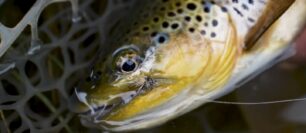
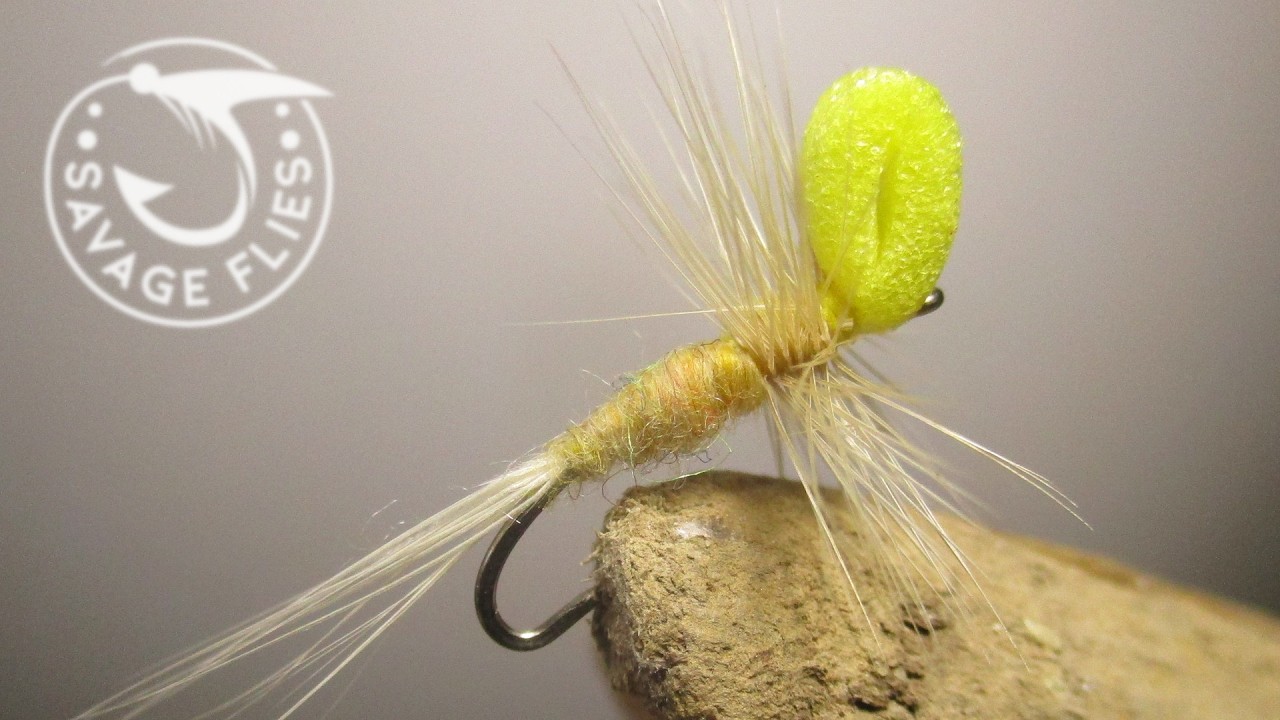
The Foam Hat Mayfly is an original pattern from Matt O’Neal of Savage Flies, developed the fall before last going into winter. It began as a simple tail, body, and hackle pattern—tied small in sizes 18 and 20 on a curved 3x-long hook, in natural browns and grizzly—that O’Neal was fishing successfully on the Savage River through December and into mid-January, including on the small brook trout tributaries of the Savage River State Forest. The distinguishing feature he added was a small loop of foam tied in front of the hackle. That single element changed the fly’s behavior: after getting pulled under in fast water, the foam slowly lifts it back toward the surface on the swing, imitating an emerging insect or a spent adult that has fallen back onto the water. For the tutorial, O’Neal scaled the design up and tied it as a sulphur, demonstrating how the same construction can become any mayfly on the calendar simply by adjusting color and hook size.
Construction is straightforward. A tail of hackle fibers and a slim dubbed body carry the silhouette of the natural, while a soft dry-fly hackle collar adds leggy movement and minimal surface support. The defining element is a strip of 2mm foam—about a hook gap wide—tied in near the eye and folded back into a compact loop before the hackle is wound in front of it. That foam post does most of the flotation work, keeping the fly riding in or just beneath the surface film even after it’s been dragged through a fast run. Because the entire dressing is color-adaptable, the same tying sequence produces a sulphur in pale yellow, a March Brown in amber and brown, a PMD in a creamy pink, or a Blue-Winged Olive in olive and gray—whatever the hatch demands.
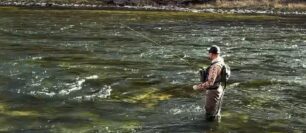
Fish the Foam Hat Mayfly in moderate to fast water—the kind of broken riffles and pocket water where trout hold looking up. Without floatant it will ride low, settling into the film where it looks like an emerging dun struggling free from the shuck, or a spent adult that has returned to the water to die after laying eggs. If the current pulls it under during a drift, the foam brings it slowly back to the surface on the swing—a moment that frequently triggers strikes. The pattern is especially worth carrying through sulphur and March Brown season, when fish can become selective and a fly that occupies the transitional zone between surface and subsurface often outfishes both a dry and a nymph fished separately.
Tying materials
Hook: #14–20, curved shank, 3x long
Thread: Any color to match the naturals
Tail: Hackle fibers, any color to match
Body: Any dry-fly dubbing, color to match
Post: 2mm foam, any light color, cut approximately one hook gap wide
Hackle: Dry-fly hackle, any color to match