
A good crab fly for redfish is built around three things before it is built around realism: it rides with the hook point up so it stays out of oyster and grass, it lands soft so it doesn’t spook a tailing fish in inches of water, and it’s tied from synthetic materials tough enough to survive being crushed and dragged all day. Where you lash the weight sets how it falls, and matching that weight to the depth matters more than how closely the fly resembles a fiddler.

That order matters because redfish, Sciaenops ocellatus, feed nose-down on the bottom. Their mouth points slightly down and they crush shells with hard plates in the back of the throat, so a crab fly needs to work on or just off the bottom, and its durability problem is abrasion, not teeth. Synthetic bodies outlast natural fibers against that grinding.
Weight the fly for the depth
Where you tie the dumbbell eyes decides the fall. Eyes in the standard Clouser position, about a third back from the hook eye, drop the fly level. Eyes near the hook eye make it dive nose-first. Eyes lashed back near the bend make it fall rear-first, claws-up, which is the posture most crab imitations want.
Heavier is not better. For most flood-tide fishing, a soft landing and an unhurried drop beat a fast sink, because the fish is already nose-down in shallow water and a hard entry blows the shot. Bead-chain eyes give the softest landing and slowest sink for spooky fish in thin water; non-lead wire lashed along the shank gives the finest control; brass runs about 30 percent lighter than lead; tungsten runs about 30 percent heavier in a smaller profile when you need to get down. Tie the same pattern in two or three weights and let the depth pick. Reach for light or bead chain on the flooded grass, and add weight when you move off into deeper potholes and creek mouths.
Ride it hook-point-up
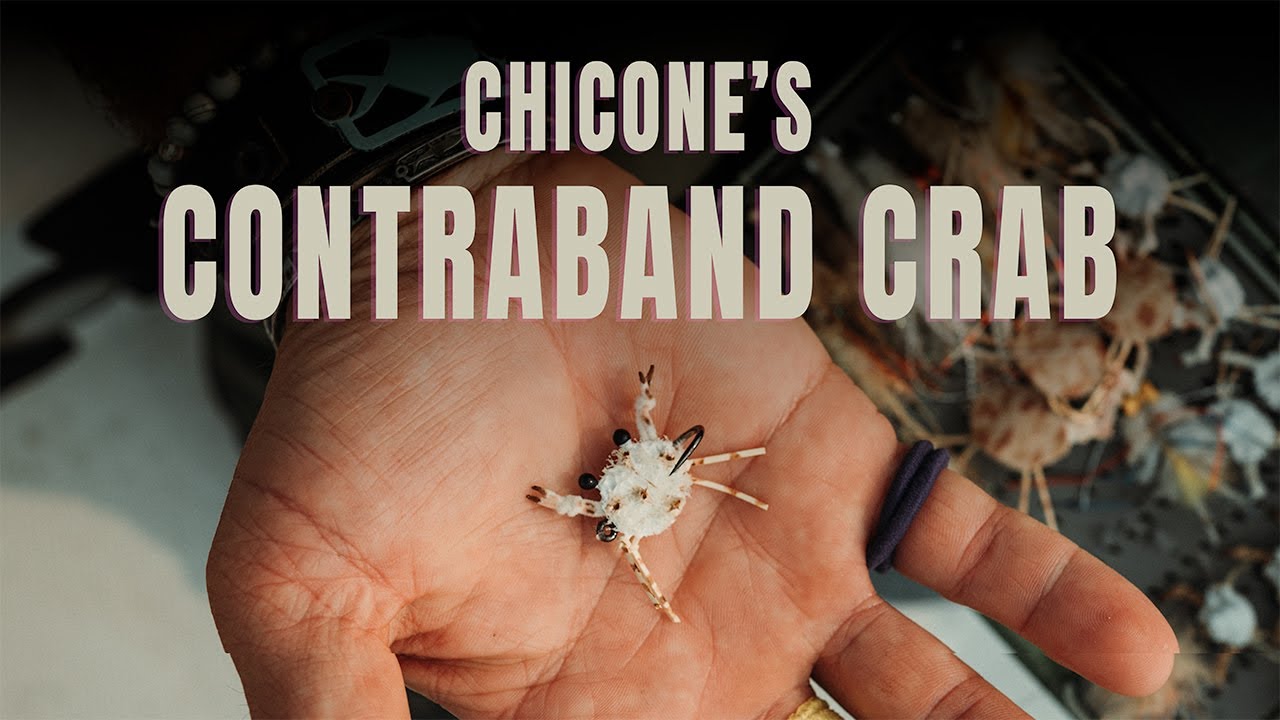
A bottom crab should ride with its point up to stay out of grass and oyster. Two ways get you there. Tie the weight on the side you want to ride down and the bulky, buoyant material, deer hair, craft fur, or EP fibers, on top, so it flips the point up like a parachute. Or start with a jig hook, where the leader tie-in sits above the hook’s center of mass and the point rides up on its own. For size 2 and size 4 crabs, a jig hook is the surest guarantee of the ride.
Build it to survive oyster and grass
Durability decides how many fish a fly is good for. Keep wool and yarn out of the body, since they waterlog over a session and change the sink rate; when Umpqua updated the Strong Arm Merkin in 2024, it went to a McFlyFoam body instead of wool for that reason. Use synthetic bodies, EP fibers, McFlyFoam, or Scotch-Brite, and lock down thread wraps and heads with a UV resin like Solarez or Loon. Treat the weed guard as part of the design: a loop of stiff 30-pound Mason hard mono, single or double prong, is the difference between fishing the grass and un-snagging in it. Keep it only as stiff as it needs to be, since the guard and a bulky head both cut into the hook gap the point needs to bite.
Rigging and presentation
An 8-weight with a floating line is the standard, dropping to a 6 or 7 for small flies in calm wind. These fish aren’t leader-shy on the flood, so a 7-to-9-foot tapered fluorocarbon leader, roughly 20-pound butt to a 16- or 12-pound tip, works well; fish fluorocarbon for its abrasion resistance in grass and oyster, not for invisibility. Lead the fish, let the crab drop into its path, twitch once to kick the legs, then let it sit. Most eats come on the fall or the first short strip, so watch for the fish to tip down and strip-strike.
Tie for the abuse, weight it for the depth, and give it a working weed guard, and the fly will fish the flood far better than a photo-realistic one that lands hard and fouls.
FAQ
What size hook is best for redfish crab flies?
Size 2 is the workhorse for most redfish crabs, with size 4 for small fish and clear, skinny water and size 1 to 1/0 for bigger patterns or dirtier water. Prefer a heavier-wire, short-shank, wide-gap hook for solid hook-ups and tying room. Jig hooks in size 2 and size 4 are worth using when you want a guaranteed hook-point-up ride.
How much weight should a redfish crab fly have?
Match the weight to the depth and how spooky the fish are, rather than maxing it out. Use bead-chain eyes or non-lead wire for a soft landing on shallow flooded grass, and step up to lead or tungsten dumbbells (about 5/32 to 3/16 inch) for deeper potholes, creek mouths, wind, or stained water. Tying the same pattern in two or three weights covers most situations.
Why should a redfish crab fly ride hook-point-up?
A point-up ride keeps the hook out of the grass and oyster the fly is dragged across, which cuts fouling and snags. You get it either by tying the weight on the bottom and buoyant material on top so the fly flips over, or by using a jig hook whose geometry rides point-up on its own.
When is the fall flood-tide redfish season?
September through November is the prime flood-tide window in the Lowcountry, from South Carolina through Georgia into north Florida. The bite runs about two hours either side of the high tide, on the bigger new- and full-moon tides that flood the short grass. It closes when water drops below about 65 degrees, usually by mid-to-late November, and the fish move off the grass for winter.
Do redfish really eat mostly crabs?
Crabs are an important part of a redfish’s diet, but the widely repeated “70 percent” figure overstates it. Controlled studies put crabs lower and show the share rises in fall and spikes locally on flooded fiddler flats, while baitfish and shrimp remain major foods. Crab flies shine in the fall marsh because that’s where and when crabs matter most, not because they dominate the diet everywhere.


