

The Florida Keys palolo worm hatch is an annual late-May to early-June spawning event in which polychaete worms drift to the surface at dusk at ocean-side bridges like Channel Five and Bahia Honda, drawing migrating tarpon into visible surface feeding. The event runs four to six consecutive nights when tide strength aligns — not necessarily on the full moon — and the right setup is a 12-weight rod, a 1/0 palolo pattern, and a slower, across-current retrieve that stands out from the thousands of naturals in the water.
When the Palolo Worm Hatch Happens — and Why the Full Moon Is a Rough Proxy
The Florida Keys palolo worm hatch is most reliable in late May and early June, with the broader window stretching from early May into July. Bruce Chard, a veteran Keys guide whose Fly Fisherman account is the most detailed guide-voice description in print, argues that current strength and timing matter more than a single moon phase. Mean tidal range at Key West (NOAA station 8724580) is only 1.28 feet, so the event concentrates where geography accelerates flow — Channel Five Bridge, Bahia Honda, ocean-side channel edges with hard bottom close to depth. Water temperatures at Vaca Key average 82°F in May and 85°F in June, the thermal envelope for both worm spawning and the Keys tarpon spring run (Griffin et al., 2022: mean arrival late April, mean departure early June). Plan for four to six consecutive feedable evenings under favorable conditions, not a single magic night.
What Works: Flies, Tackle, and Presentation
A 12-weight saltwater rod with either a floating line or a clear intermediate tip is the standard. Leaders run 9 to 15 feet depending on clarity, with 12-, 16-, or 20-pound class tippets and a 60-pound fluorocarbon bite tippet. Fly selection centers on three proven commercial patterns: RIO’s Palolo Worm in 1/0 (about $4.25 each at Florida Keys Outfitters, $67.99 for a 12-pack from RIO), Drew Chicone’s Peyote Palolo in 1/0 or 3/0 (Umpqua) with its short-shank hook and foam-strip wake control, and Gordon Baggett’s Stiff Worm in 1/0. Colors cluster in reds, pinks, and rusts with contrasting chartreuse, olive, or tan heads. Naturals are typically two to three inches with pink bodies and tan or pale greenish heads.
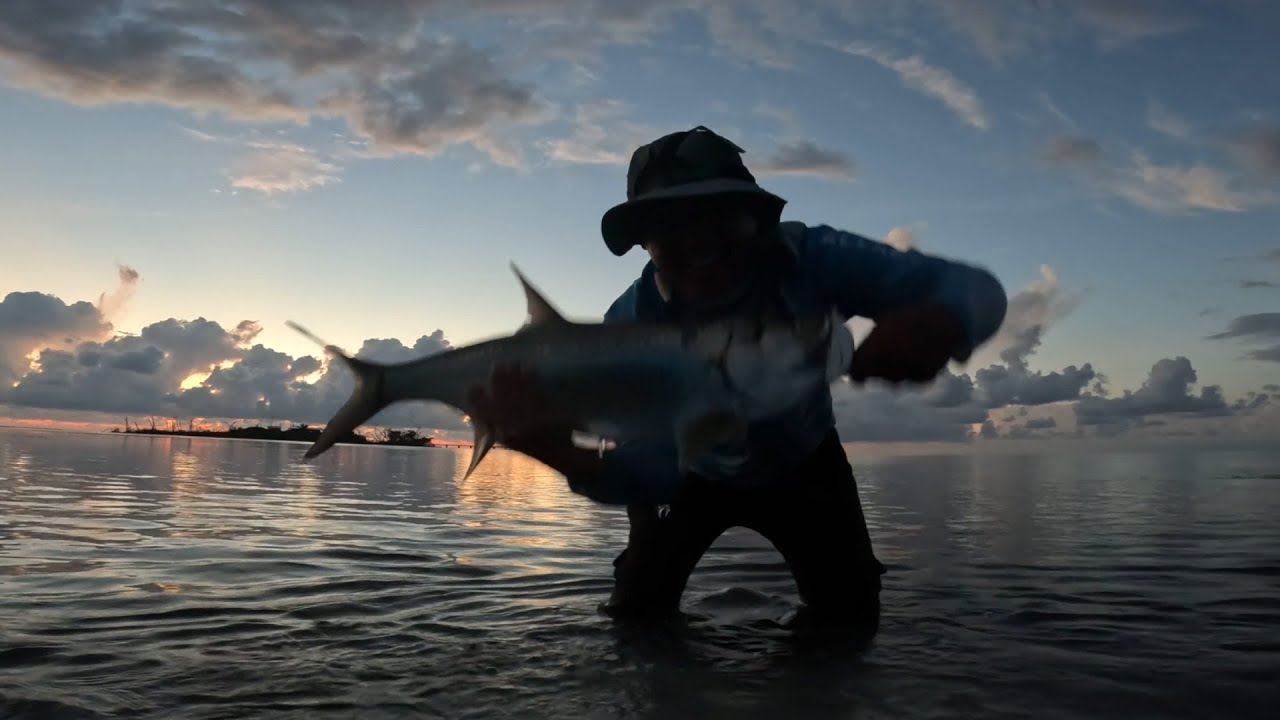
The single most important insight is also the most counterintuitive: do not match the hatch directly. When the surface is saturated with thousands of worms drifting downcurrent, a fly moving the same way blends in. A slower, across-current presentation that keeps the fly in the fish’s visual window longer and travels on a different vector gives a tarpon something to track. Baggett’s system calibrates strip speed to current; Chard advocates across-current angles to break the pattern. Both accept that detection, not imitation, is the binding constraint.
Rules, Access, and Logistics
Tarpon in Florida are catch-and-release only. Fish over 40 inches must stay in the water unless the angler holds a tarpon tag for state or world record pursuit ($51.50 in the 2026 Florida saltwater regulations booklet). Most of the fishery sits inside Florida Keys National Marine Sanctuary, which prohibits anchoring on coral, prop-scarring seagrass, and fishing in Sanctuary Preservation Areas. Bahia Honda State Park offers a public ramp; FWC’s Florida Keys Boating Guide lists additional Lower and Middle Keys ramps. Independent anglers need a Florida saltwater license; charter clients are typically covered by the captain’s credentials. Published 2026 guide rates from Florida Keys Outfitters, Casting Tales, and other Islamorada and Lower Keys operators run in the high triple to low four figures per day.
Bottom Line
Plan the trip around the tide window — not the full moon — and book a flexible itinerary that can absorb a blown night. Carry three color variants of a 1/0 palolo pattern, a 12-weight rod, and both a floating and an intermediate line. Fish across-current, slower than the naturals. Treat the event as a week, not a date, and expect the surface chaos to be humbling even when you do everything right.
FAQ
When is the palolo worm hatch in the Florida Keys?
The Florida Keys palolo worm hatch typically peaks in late May and early June, with activity possible from early May into July. Current strength and timing matter more than moon phase — some May full moons produce nothing, while cold-fronted June tides can produce the event of the year.
What fly do you use for the palolo worm hatch?
RIO’s Palolo Worm in size 1/0, Drew Chicone’s Peyote Palolo (1/0 and 3/0), and Gordon Baggett’s Stiff Worm in 1/0 are the standard patterns. Stick to pink, red, or rust bodies with contrasting chartreuse, olive, or tan heads. Keep the fly simple, foul-resistant, and tied on a strong short-shank hook.
What rod and line are best for palolo worm tarpon fishing?
A 12-weight saltwater rod is the ideal. Floating lines suit visible surface activity; intermediate sink tips often perform better in wind, surface grass, or when you need finer control over fly speed against a ripping current. Leaders run 9–15 feet with 12-, 16-, or 20-pound class tippets and a 60-pound fluorocarbon bite tippet.
Where in the Florida Keys is the palolo worm hatch best?
Ocean-side bridges and channel edges with hard bottom near depth, including Channel Five Bridge and Bahia Honda. The fishery concentrates where geometry accelerates current — and occasionally on open flats with lots of hard-bottom corals — and sits largely inside Florida Keys National Marine Sanctuary boundaries.
Do you need a license to fish during the palolo worm hatch?
Yes. A Florida saltwater fishing license is required for independent fishing, including from bridges or shore. On a licensed charter, anglers are typically covered by the captain’s credentials. Tarpon are catch-and-release only statewide, and fish over 40 inches must remain in the water unless pursued under a tarpon tag.


