
A Skagit head in the 500–575 grain range paired with two interchangeable tips — a MOW Heavy (T-14) and 10 feet of T-11 — covers the majority of spring steelhead swing-fishing situations for under $160. The key to choosing the right sinking line system for April steelhead isn’t chasing the fastest sink rate; it’s matching tip length and density to water conditions that can shift daily as rivers transition between high, cold runoff and fishable, clearing flows. Understanding three primary line systems — integrated sink-tip lines, Skagit-plus-tip setups, and full-sink heads — lets you build a kit that adapts without overbuying.
How Skagit Tips and MOW Systems Control Depth
The Skagit head-plus-tip system dominates spring steelhead because it separates casting load from depth control. A compact shooting head — the OPST Commando Head (about $65) or RIO Elite Skagit Max Power (about $65) — loads the rod and turns over heavy flies, while interchangeable tips adjust depth. RIO’s MOW tips ($30 each) maintain a fixed overall length of 10 or 12 feet, varying the ratio of floating-to-sinking material: a 5/5 MOW Heavy delivers five feet of floating line fused to five feet of T-14 for tailouts and inside edges, while a full-length T-11 or T-14 tip handles deeper runs.

Published sink rates across common tungsten tips are closer than most anglers assume. T-8 sinks at 6–7 inches per second, T-11 at 7–8 ips, and T-14 at 8–9 ips — a total spread of roughly two inches per second in still water. In moving current, tip length often matters more than density: a longer tip of the same T-designation sinks deeper because more weighted material enters the water column, not because it falls faster. For high, cold water below 42°F, run 10–12 feet of T-14. As rivers drop, shorten to 6–7 feet or switch to T-8 before changing density class entirely.
Integrated Sink-Tip Lines for Simpler Setups
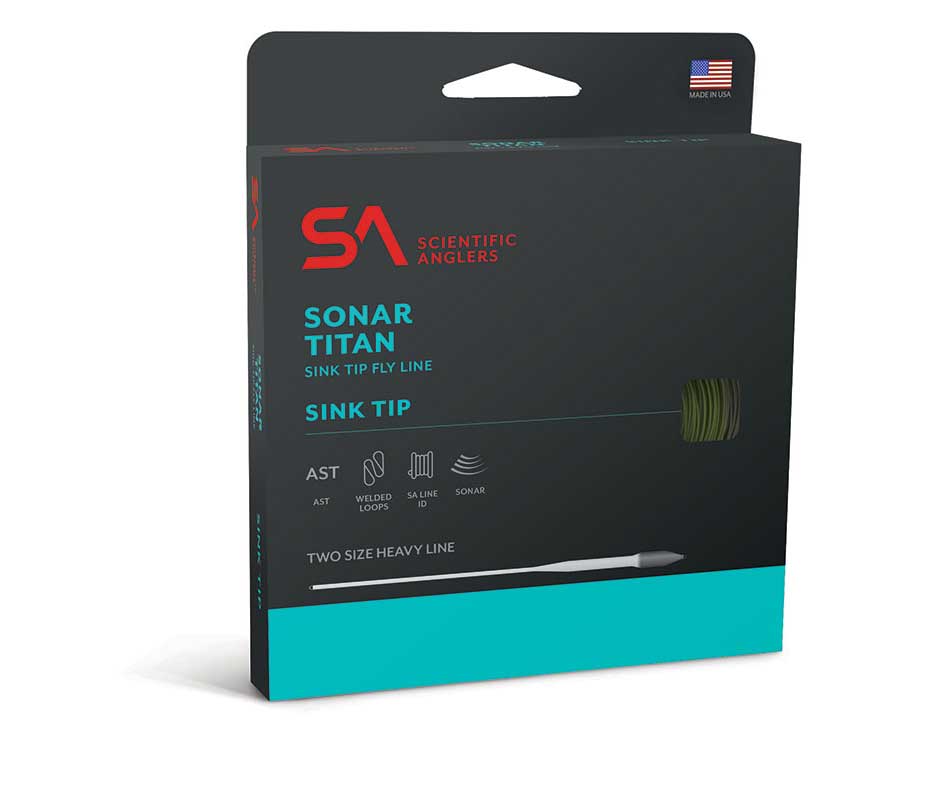
Anglers who prefer a single-line approach have two strong options. The RIO Elite MDC VersiTip (about $200) includes four 12-foot interchangeable tips — floating, hover/intermediate, intermediate/S3, and S3/S5 — on a 35-foot head, covering light-to-moderate sink requirements without separate heads or running lines. The Scientific Anglers Sonar Titan Sink Tip (about $100) builds the sink tip directly into a weight-forward line, with tip lengths scaling from 8 feet on a 5-weight to 16 feet on a 9/10-weight and density options from intermediate (1.25 ips) to S6 (5.5–6.5 ips).
For deep, slow pools where the entire line needs to pull the fly down, the SA Sonar Sink 25 Cold (about $100) offers a 25-foot fast-sinking head at 4.0–8.0 ips with cold-water coating designed to resist stiffness in April morning temperatures. Airflo’s Depthfinder runs 6.0–7.5 ips with closeout pricing often in the $70–$90 range.
Cast Angle and Mend Timing as Free Depth Control
Before buying a heavier tip, adjust your approach. Casting more directly across-stream rather than downstream gives the tip extra seconds to sink before the swing engages. An early upstream mend that moves the head — not just the running line — extends sink time further. Stepping down with the drift adds even more sink time before tension locks in. Below 42°F, this combination can substitute for a full step up in tip density, keeping your fly in the zone without adding gear.
Fly selection interacts directly with your sink system. In cold water below 45°F, intruder-style patterns in the 3- to 4-inch range — black/blue or pink/orange — provide the profile and movement that sluggish steelhead respond to. These larger flies pair naturally with heavier tips and the compact Skagit heads designed to turn them over. As water warms and clears past 45°F, scale down to 1.5- to 2-inch patterns or traditional hairwings like the Green Butt Skunk in sizes 2–6, and shift to lighter tips accordingly. Behind any sink tip, a short leader of 3–4 feet of 12–16 lb fluorocarbon maintains the depth advantage the tip creates — longer leaders allow the fly to ride above the sinking zone and defeat the purpose of the system.
Frequently Asked Questions
What is the difference between T-8, T-11, and T-14 sink tips?
The T-number indicates grains per foot of tungsten material, which correlates with sink rate. T-8 sinks at 6–7 ips, T-11 at 7–8 ips, and T-14 at 8–9 ips. The practical difference in moving water is modest — roughly two inches per second across the full range — which is why tip length and casting geometry often matter more than stepping up one density class.
Do I need a Skagit head to swing flies for spring steelhead?
No, but a Skagit system offers the most versatile depth control. Integrated sink-tip lines like the RIO Elite MDC VersiTip or SA Sonar Titan Sink Tip work well for anglers who want a simpler setup. The tradeoff is less granular tip selection — you’re limited to the densities included with the line rather than a full wallet of interchangeable options.
Should I include tip weight when choosing a Skagit head grain weight?
This depends on the head design. OPST recommends adding tip weight (often 100–150 grains) to head weight when sizing their Commando system. Other manufacturers, including some longer-head Skagit designs, advise sizing the head to your rod’s grain window independently of the tip. Start within the head manufacturer’s recommended grain range and adjust based on casting feel.
What sink tip should I use for high, cold spring steelhead water?
Run 10–12 feet of T-11 or T-14 behind a 500–575 grain Skagit head when water temperatures are below 42°F and flows are elevated. Pair with 3–4 inch intruder-style flies in dark or contrast colors, a steep across-stream cast angle, and an aggressive upstream mend to maximize sink time before the swing.
How much does a basic Skagit sink-tip system cost?
A functional spring steelhead Skagit setup starts around $155–$160: a Skagit head ($65), one MOW Heavy tip ($30), and a 30-foot spool of Level T-11 ($60) cut to 10- and 12-foot lengths. Add a running line ($30–$40) if you don’t already have one. This two-tip kit handles the vast majority of April swing-fishing water.